From First Touch to Daily Practice
Everything you need to use cow urine, cow dung, ghee, and Panchagavya safely, comfortably, and effectively — with full control over odour.
The most valuable active substance in cow urine is urea — responsible for almost all therapeutic benefits, yet also the source of the smell. Urea itself is odourless; the strong scent appears only when bacteria break it down into ammonia. Our goal: eliminate the smell, but keep urea fully intact and active.
Well-known authors advise using camphor or mint oil to mask odour. Camphor can actually speed up bacterial activity, accelerating breakdown of urea into ammonia. Mint is too light to cut through heavy ammonia-based odours. Our recommendations eliminate odour completely, stop the reaction that creates smell, and fully preserve urea and all healing properties.
2–3 drops per 100 ml
Best overall: strong, fresh, citrus-woody scent. Contains citral, which kills bacteria, neutralises ammonia chemically, and stops the enzyme that breaks down urea. 100% safe, preserves all potency.
1–2 drops per 100 ml
Deep, warm, woody, very long-lasting. Heavy molecules form a protective barrier, slow evaporation, lock in active ingredients, and permanently bind odour molecules.
1–2 drops per 100 ml
Powerful antibacterial and deodorising action. Very effective at neutralising heavy organic smells; gentle enough not to alter active compounds.
1 drop per 100 ml
Extremely strong antimicrobial; cuts through ammonia and earthy odours instantly. Use slightly less — very potent.
2–3 drops per 100 ml
Balanced, reliable, fresh-medicinal scent. Neutralises odour well and protects the chemical stability of the urine.
Recommended ratio: 2 drops Lemongrass + 1 drop Cedarwood per 100 ml. Together: zero smell, 100% potency, and a pleasant, clean, fresh-woody aroma.
Add your chosen oil(s) first, swirl gently — do not shake vigorously.
Store in a dark, sealed glass jar or bottle, away from heat and sunlight.
Cow urine does not spoil quickly — it actually matures and improves over time. It remains fully effective for at least 1 year, and can keep its properties for several years when stored properly.
Face, neck, chest, arms, legs, or the whole body.
Until fully absorbed or almost dry.
You may leave it on or rinse with water after 15–30 minutes. No soap needed.
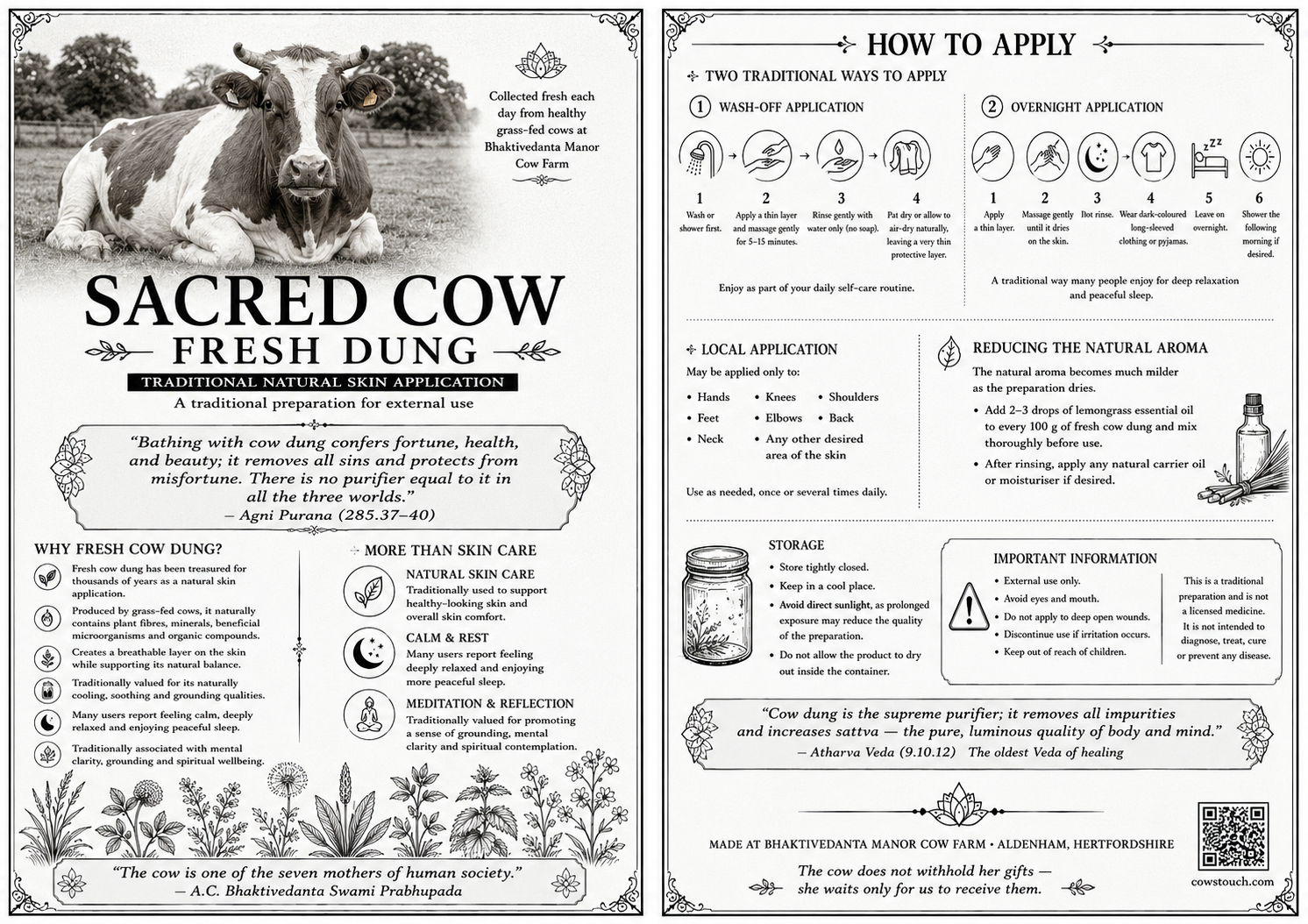
Fresh dung from cows fed a clean, natural diet is always best. Organic dung from traditional Indian breeds such as Gir or Sahiwal has a naturally mild, earthy scent. Dung from standard dairy breeds may carry a stronger odour, yet it remains fully effective. Always collect fresh deposits, never old or aged piles. For the greatest energetic potency, source it from places where cows are treated with love and care — such as Hindu temples or traditional goshalas.
Fresh cow dung retains its full quality for roughly one month at room temperature. Store in a small lidded jar. A 100–300 mg portion is enough for 2–3 weeks of application. Replace with fresh dung every 2–3 weeks.
For regular practice wear dark-coloured underwear or pyjamas. Wool is ideal — it naturally regulates body temperature and helps manage odours.
Once dry, cow dung has almost no scent at all. Apply, massage in, and wait until fully dry. Speed drying with a hairdryer, or cover immediately with clothing — your body heat dries it in 5–15 minutes. Drying alone resolves 70–100% of the odour issue.
Add 2–5 drops of essential oil to the dung before applying. Use the same Top 5 oils from the Cow Urine section. Best choice: Lemongrass + Cedarwood blend.
A thin layer of Gopi Chandan Tilak — the pure organic clay used by Krishna devotees, sourced from the banks of the River Ganga — creates a perfect seal, blocking all odour molecules. It is smooth, easy to apply, and has a gentle, pleasant fragrance.
Apply a small amount of fresh dung — about the size of half a walnut. Rub between your palms, then spread lightly over the skin. Massage gently for 5–15 minutes. Rinse off with water only — do not use soap.
The first benefits you will notice are improved mood, easier breathing, and deeper, more vivid dreams.
Apply a thin layer, then immediately put on your dedicated dark cotton pyjamas. Within 5–15 minutes the dung dries and any remaining odour disappears. A thin coating is always enough — regularity matters far more than thickness.
Apply in your bedroom and rinse off in the bathroom later. A quick spray of room fragrance covers any trace. If you add the recommended essential oils, you will avoid this issue entirely.
The first time you hold fresh cow dung, you may feel a moment of resistance. That is not your body reacting — it is social conditioning. Once you experience the benefits, any hesitation will vanish completely.
Using both together gives you the full synergy of their healing properties. Always add your chosen essential oils to the urine and/or dung first, before mixing or applying.
Add essential oils to the cow urine in advance.
Apply cow urine to the skin and massage thoroughly until almost dry — leave it slightly damp. This wetness acts as a natural carrier, making it easier to spread the dung.
Apply a thin coat of cow dung directly over the slightly damp urine layer. Spread evenly.
Once the dung starts to dry, apply a fine layer of Gopi Chandan Tilak clay over the top.
Add essential oils to the cow urine first.
Combine fresh cow urine and cow dung in a small container and stir until you have a smooth, consistent paste.
Massage the mixture onto your skin in a thin, even layer.
Let it air dry until almost dry, then finish with a light layer of Gopi Chandan Tilak clay on top.
Ghee is known in Ayurveda as the "carrier of potency" — it nourishes, protects, and helps other active substances absorb more deeply. Safe, gentle, and suitable for all ages and skin types.
Start with ½ to 1 teaspoon taken first thing in the morning on an empty stomach, or added to warm water, herbal tea, or warm milk. 1–2 teaspoons per day is usually enough.
Use as your main cooking fat. High smoke point — does not break down or form harmful compounds when heated.
Gently in a cup or your palms until it turns liquid.
Use long, smooth strokes on arms and legs, and soft circular motions on joints, chest, and abdomen.
This gives it time to absorb and soften the skin.
With warm water. You can use a mild, natural cleanser or simply wipe away excess with a warm cloth.
Keep in a clean, dry, sealed glass jar away from direct sunlight. When pure and properly made, ghee remains stable for 6–12 months at room temperature, and can last several years in a cool, dark place.
Panchagavya is a complete preparation combining all five cow products. Correct preparation and maturation are essential.
| Ingredient | Parts |
|---|---|
| Cow Dung | 5 parts |
| Cow Urine | 5 parts |
| Cow Milk | 2 parts |
| Curd | 2 parts |
| Ghee | 1 part |
In a clean glass or earthenware jar.
2–3 drops Lemongrass + 1–2 drops Cedarwood per 100 ml total volume.
Once or twice daily. Cover loosely — do not seal airtight, as natural fermentation occurs.
Leave in a cool, shaded place for 7 to 14 days.
Once matured. Remains effective for many months to over a year.
Apply a thin layer over the skin and massage gently. Leave for 15–30 minutes, then rinse with warm water only.
Dilute 1 part Panchagavya with 3–4 parts clean water. Soak a cloth and apply to the area of need.
For longer application, finish with a light layer of Gopi Chandan Tilak clay to lock in all benefits.
Only use fully matured preparations — never take fresh, unfermented mixtures internally. Start with 1 teaspoon per day on an empty stomach. Consult a qualified Ayurvedic practitioner if you have existing health conditions.
Keep in a clean, dark glass jar sealed tightly once fully matured. When prepared correctly, Panchagavya improves with age and remains effective for up to 1–2 years.